Santa’s Reindeer Names in Order: All 9 and What They Mean
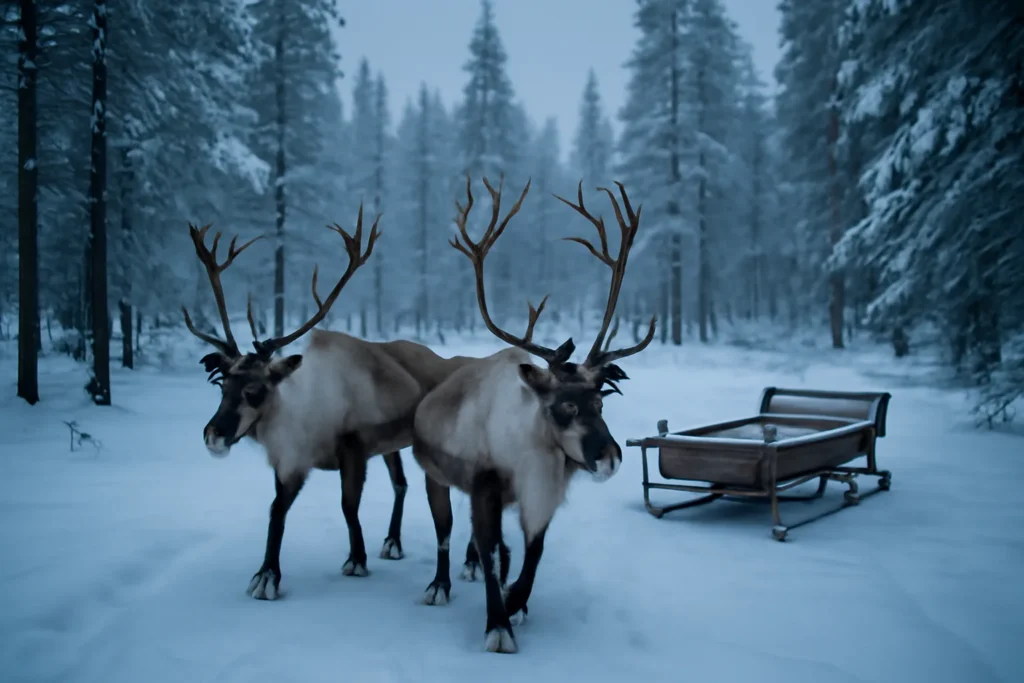
Santa has nine reindeer: Dasher, Dancer, Prancer, Vixen, Comet, Cupid, Donner, Blitzen and Rudolph. That’s the order in which the 1823 poem A Visit from St. Nicholas calls out the first eight, and Rudolph, the one with the red nose, joined the team in 1939 and now leads the sleigh.
If a small person just asked you to name them all and you got stuck somewhere after Vixen, you’re in good company: almost everyone forgets Comet or Cupid. The table below has all nine in order, with what each name means. Further down is the bit of trivia kids love most: going by biology, the reindeer wearing antlers on Christmas Eve would be girls (or young males).
All 9 reindeer names in order, and what each one means
Most of the names are ordinary English words, which is part of their charm: each one hints at a personality. Two of them, Donner and Blitzen, come from Dutch and German. Here is the full team, in the order of the poem, with Rudolph at the end.
| # | Name | Meaning |
|---|---|---|
| 1 | Dasher | The one who dashes off and runs fast |
| 2 | Dancer | The one who dances |
| 3 | Prancer | The one who leaps and prances with style |
| 4 | Vixen | A female fox |
| 5 | Comet | The celestial body with a bright tail |
| 6 | Cupid | The Roman god of love |
| 7 | Donner (earlier Dunder and Donder) | Thunder, in Dutch and German |
| 8 | Blitzen (earlier Blixem) | Lightning, in Dutch and German |
| 9 | Rudolph | A given name; the reindeer with the red nose |
The last two names in the poem changed over time. In the 1823 printing they appear as Dunder and Blixem, Dutch forms of thunder and lightning and a nod to New York’s Dutch past. Later editions switched to Donder and Blitzen, and the Rudolph song in 1949 made the spelling Donner the popular one. So if your child’s storybook says Donder and the song says Donner, both are right.
From one reindeer in 1821 to eight in 1823
Reindeer joined the Santa story in the United States in the early 1800s. In 1821, an illustrated booklet published in New York showed the jolly old man, called “Santeclaus” there, riding a sleigh pulled by a single reindeer and delivering gifts to children.
Two years later, in 1823, the poem A Visit from St. Nicholas, also known as The Night Before Christmas and attributed to Clement Clarke Moore, ran unsigned in a newspaper in Troy, New York. The poem grew the team: now there were eight tiny reindeer, each called by name as the sleigh rose to the rooftops on Christmas Eve.
Reindeer were a natural choice. They are the draft animal of the Arctic, used for centuries to pull sleds in Lapland and Siberia. By putting reindeer in front of the sleigh, the writers tied Santa to the cold far north, an idea that later settled into the North Pole home drawn by cartoonist Thomas Nast.
Rudolph the Red-Nosed Reindeer arrived in 1939
Rudolph the Red-Nosed Reindeer was created in 1939 by Robert L. May, an advertising copywriter for a Chicago department store chain, for a Christmas booklet given free to children who visited the stores. In the story, the reindeer teased for his shiny red nose ends up chosen to guide the sleigh on a very foggy Christmas Eve.
The character went global ten years later. In 1949, Johnny Marks, May’s brother-in-law, turned the story into a song, recorded by singer Gene Autry, and it became a hit in the United States. In 1964, an animated TV special made with stop-motion puppets fixed Rudolph’s image for several generations.
That’s why the reindeer count depends on the source: eight in the 1823 poem, nine once Rudolph arrived. In most versions today, Rudolph leads the team at the front of the line, with his nose working as a headlight.
The message helps explain why the story caught on: the reindeer left out for being different is the very one who saves Christmas. It’s a great starting point for talking with kids about respecting differences.
Real reindeer: they don’t fly, and the females have antlers too
Real reindeer exist, and they belong to the species Rangifer tarandus, the same animal as the North American caribou. They live in the cold regions of the Northern Hemisphere, including Norway, Sweden, Finland, Russia, Alaska, Canada and Greenland, and no, they don’t fly.
A few fun facts help separate the myth from the biology:
- Both males and females grow antlers. The reindeer is the only deer species in which females usually have antlers too.
- Antlers fall off and grow back every year. Adult males shed theirs in late fall, around the start of winter. Females and young reindeer keep their antlers through the winter, until spring.
- Their winter diet is lichen. Reindeer dig through the snow with their hooves to eat reindeer lichen, which carpets the tundra floor. In summer they eat leaves, grasses and mushrooms.
- Arctic peoples herd them. The Sámi people of northern Norway, Sweden, Finland and Russia’s Kola Peninsula have herded reindeer for centuries for meat, hides and transportation. Reindeer-pulled sleds are real.
| In the story | In nature |
|---|---|
| They live at the North Pole | They live on the tundra and in the cold forests of the Arctic, not at the pole |
| They fly while pulling the sleigh | They pull sleds on the ground, over snow |
| All of them have antlers at Christmas | Adult males have already shed their antlers by then |
| They eat carrots left out by children | They eat lichen, leaves and grasses |
So, going by biology, the reindeer pulling the sleigh on December 24, all of them wearing antlers, would be females or young males. The poem never said whether any of them were male or female, but this bit of trivia is usually a big hit with kids.
A memory game, a reindeer race and a snack by the door: reindeer fun with kids
Santa’s reindeer make for easy activities during the final week before the big day, which in 2026 runs from Sunday, December 20, to Friday, December 25. A few ideas that work in any climate:
- Reindeer memory game: draw the nine reindeer on pairs of cards, each with a detail tied to its name, like a lightning bolt for Blitzen and a ballet slipper for Dancer.
- Favorite reindeer in the letter: ask your child to tell Santa which reindeer they’d most like to meet and why. Our letter to Santa ideas can help them get started.
- Snack for the reindeer: on the night of the 24th, leave a bowl of water and a few carrot pieces on the porch or by the door, a simple take on the custom of setting out food for the reindeer. Skip the glitter and sprinkles, which just end up scattered across the yard.
- Reindeer race: with cardboard antler headbands, the kids race across the yard, each one playing a different reindeer.
- Story time: tell the Rudolph story in your own words and ask the kids what they would have done in the other reindeer’s place.
- Arctic map: show on a map where real reindeer live and compare it with where your family lives.
If your Christmas falls in summer, as it does in Australia and New Zealand, the map game gets even better: the reindeer live on the opposite side of the world, deep in their winter, while your kids are in shorts. Save the reindeer race for the cooler evening hours, and the bowl of water by the door suddenly makes a lot of sense on a warm Christmas Eve.
For more ideas to share as a family, check out these 20 Christmas activities to do together. And if you’re curious about the man holding the reins, read about the origin of Santa Claus and Saint Nicholas.
At bedtime, the reindeer pair nicely with other classic Christmas stories, and the Rudolph special is a favorite on many lists of family Christmas movies.
However many names your kids remember this year, may the night of the 24th bring a quiet house and a few little ears listening hard for hooves on the roof.
Frequently asked questions
How many reindeer does Santa have?
Nine, in the best-known version today. The 1823 poem introduced eight named reindeer, and Rudolph, the one with the red nose, was added by the 1939 story.
Which reindeer leads Santa’s sleigh?
Rudolph. Since the 1939 story, he has led the sleigh and used his shiny red nose as a headlight on foggy nights.
Are Santa’s reindeer female?
The story doesn’t say. Biologically, adult males shed their antlers around the start of winter, so reindeer with antlers at Christmas would be females or young males.
Are reindeer and caribou the same animal?
Yes. Both belong to the species Rangifer tarandus: in Europe and Asia the animal is called a reindeer, and in North America, a caribou.