How Many Christmas Lights per Tree (Chart), Energy Use & Safety
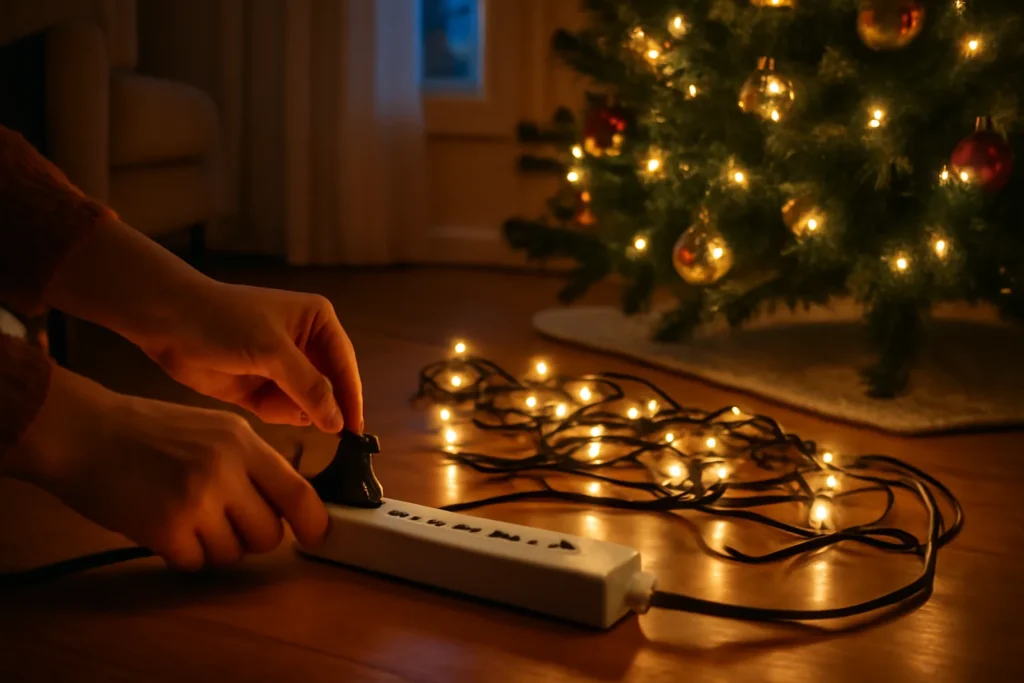
Plan on about 100 mini lights for every 30 cm (1 ft) of tree: roughly 600 for a 1.8 m (6 ft) tree. Choose LED, look for a safety certification such as UL or ETL (or your local equivalent), and buy outdoor-rated sets for anything that goes on a porch or in a window that catches rain.
If you’ve ever had a strand that worked perfectly in the store and died in the living room on day two, it usually isn’t bad luck: it’s a damaged cord, an overloaded outlet or too many sets plugged end to end. The good news is that with LEDs, a tree lit every night until Epiphany adds very little to your power bill. The math is just below.
How many lights per tree: 100 for every 30 cm (1 ft)
For the tree, a handy rule of thumb is about 100 lights for every 30 cm (1 ft) of height. Fuller trees call for a few more, and if you like a subtle look you can use fewer.
| Tree height | Lights (guideline) |
|---|---|
| 60 cm (2 ft) | about 200 |
| 90 cm (3 ft) | about 300 |
| 1.2 m (4 ft) | about 400 |
| 1.5 m (5 ft) | about 500 |
| 1.8 m (6 ft) | about 600 |
For windows, porches and the front of the house, measure the outline with a tape measure and add the distance to the outlet, so you know whether the lead cord will reach without splicing anything. If your tree looks sparse even with plenty of lights, our tips on making a Christmas tree look fuller can help.
How much electricity Christmas lights use
You can work it out from the box: watts × hours per day × days ÷ 1,000 = kWh. Then multiply by the rate per kWh on your electricity bill, which varies by provider and by country.
Here’s an example with 100-bulb strands, on for 6 hours a night for 40 days (from late November to Epiphany). The actual wattage of each model is printed on the package; the figures below are a reference for comparison:
| Setup | Wattage | Use over 40 days |
|---|---|---|
| 1 LED strand, 100 bulbs | 6 W | 1.4 kWh |
| 1 incandescent strand, 100 bulbs | 40 W | 9.6 kWh |
| 1.8 m (6 ft) tree with 6 LED strands | 36 W | 8.6 kWh |
| 1.8 m (6 ft) tree with 6 incandescent strands | 240 W | 57.6 kWh |
| The same 6 LED strands left on 24 hours a day | 36 W | 34.6 kWh |
In other words, LEDs use a fraction of what incandescent bulbs do, and the thing that weighs most on the bill is leaving the lights on all day. A plug-in outlet timer solves both problems: the bill and the forgetting.
If your Christmas falls in summer, as it does in Australia and New Zealand, it gets dark late, so there’s little point in switching the lights on at dinnertime. Set the timer to come on after sunset and turn off when you go to bed. In hot weather, the cooler running temperature of LEDs is one more reason to choose them, especially near dry branches or outdoor foliage.
Which Christmas lights to buy: 6 types and where each works
“Christmas lights” covers just about any strand of holiday lights, but the styles are quite different. Each one works best for a particular job:
| Type | What it looks like | Best for |
|---|---|---|
| Classic string lights | Green or clear wire with small bulbs | Trees, garlands, windows |
| Fairy lights | Thin, bendable wire with micro LEDs | Arrangements, glass jars, centerpieces |
| Curtain lights | Several strands hanging side by side | Windows, walls, photo backdrops |
| Icicle lights | Short strands dropping from a main line | Eaves, porches, awnings |
| Rope lights | Flexible tube with lights inside | Outlining walls, railings and garden beds |
| Battery or USB lights | Short strand that doesn’t plug into a wall outlet | Spots with no outlet nearby, small arrangements |
LED or incandescent? LED, which runs cooler and uses less
LED strings are now the best choice for most homes. They run much cooler, use less energy and usually last longer than old-style mini incandescent bulbs.
That lower heat makes a real safety difference, especially when lights sit near paper, fabric, dry branches or plastic ornaments. If you still have older incandescent strings, use them with extra care, away from anything flammable, and consider replacing them a few at a time.
As for color, warm white (yellowish) light creates a cozier mood, cool white (bluish) looks more modern, and multicolor is the kids’ favorite. It’s purely a matter of taste, with no difference in safety.
What to check on the box before you buy
A few minutes reading the package can save you a lot of headaches. Look for this information:
- Safety certification: a mark from a recognized testing lab, such as UL or ETL in the US, or the certification required where you live. It shows the product was tested to electrical safety standards.
- Electrical rating: make sure the set is made for your home’s outlets. If you bought lights abroad or online from overseas, double-check the label before plugging them in.
- Wattage: listed in watts. It helps you add up how much you’re plugging into the same outlet.
- Indoor or outdoor use: only use lights labeled for outdoor use where they’ll get rain or dew. On those products, look for the IP rating: the second number shows protection against water, and the higher it is, the better protected.
- Connecting end to end: when a strand lets you plug another into its end, the package lists the maximum number of sets you can connect. Stick to that limit.
- Labeling: the manufacturer’s or importer’s name and instructions in a language you can read.
Be wary of any product missing all of this information, with very thin, flimsy wire, a loose-fitting plug or a strong burnt-plastic smell when you turn it on.
How to install them safely
Before you hang them
- plug the strand in while it’s still on the floor, stretched out, and check that every bulb lights up;
- inspect the whole cord: throw out strands with frayed wire, cracked plugs or broken bulbs;
- don’t make makeshift repairs with tape; a damaged strand shouldn’t be used.
Indoors
- don’t run cords under rugs, behind furniture pushed against the wall, or through doors and windows that close on them;
- don’t attach them with nails, staples or tacks that could pierce the wire; use adhesive hooks or plastic clips;
- keep the controller box for the light effects uncovered, with no fabric or decorations over it;
- keep strands away from curtains, lit candles and heat sources;
- with a real tree, keep plugs and connections away from the water in the stand.
Outdoors
- use only products labeled for outdoor use;
- keep plugs and connections raised and protected from rain, never on the ground where water pools;
- turn the lights off during storms;
- when using a ladder, have someone nearby holding it and avoid going up on the roof alone;
- for larger setups or if you need a new outlet, call an electrician.
For ideas for the front of the house, the yard and the porch, see our outdoor Christmas lights guide.
Outlets and extension cords: what trips the breaker right before dinner
Overloading happens when too many devices draw power from the same point. At Christmas, it’s common to end up with string lights, light-up decorations and kitchen appliances all on one outlet. To avoid trouble:
- Don’t stack plug adapters or splitters. Use a good-quality power strip or extension cord instead.
- Respect the extension cord’s capacity: it’s printed on the product, in watts or amps. Add up the wattage of everything you’re plugging in.
- Don’t plug one extension cord into another.
- Fully unwind a reel extension cord before using it, because coiled cord heats up more.
- Spread the lights across different outlets when the display is large.
Watch for warning signs: a plug or outlet that’s hot to the touch, a burning smell, crackling sounds, lights flickering outside the programmed effect, or a tripped breaker. If any of that happens, turn everything off and unplug the strand. If the breaker trips often, it’s time to call an electrician.
Kids and pets
- keep plugs, extension cords and the effects controller out of children’s reach;
- don’t let kids handle a strand while it’s plugged in;
- loose bulbs and small parts can be swallowed; check the floor after you finish decorating;
- dogs and cats often chew on cords: hang strands higher up and check the wire often;
- with battery-powered sets, store spare batteries away from children. Button and coin batteries, common in remote controls, are dangerous if swallowed; if that happens, get medical care right away.
Day to day and after the holidays
Turn the lights off when you go to bed and when you leave the house. A plug-in outlet timer helps you stick to the routine without relying on memory. When you take everything down, around Epiphany (January 6), wind the strands without knots, store them somewhere dry and set aside any that stopped working. Broken string lights are electronic waste and should go to an e-waste collection point, not the regular trash.
Lights are the fussiest part of decorating and the part that delivers the most when they come on for the first time. Once the outlet is right and the LEDs are in place, what’s left is the best bit: turning off the room lights and watching the tree glow for a while.
Frequently asked questions
Are LED Christmas lights safer?
Generally, yes. LEDs run much cooler than incandescent bulbs, which lowers the risk near paper, fabric and dry branches. Even so, check the safety certification, the indoor or outdoor rating and the condition of the cord before using them.
How many strings of lights can I plug into one outlet?
It depends on the wattage of the strands and the capacity of the outlet or extension cord. Add up the wattage, respect the limit on connected sets listed on the package, and don’t stack splitters or plug one extension cord into another.
Can I leave Christmas lights on all night?
The safest choice is to turn them off when you go to bed and when you leave the house. An outlet timer helps switch the lights on and off at the right times without forgetting.
Can indoor Christmas lights go on a porch?
It’s not recommended. Porches and balconies get rain, dew and moisture. For those spots, use lights labeled for outdoor use and keep plugs and connections protected from water.
Do battery-powered or solar Christmas lights work well?
They work in places without an outlet, like table arrangements, wreaths and garden planters, but they’re usually dimmer and run for less time than plug-in lights. Solar lights need direct sun during the day to light up at night, and battery lights need frequent battery changes, with the batteries removed for storage.
How much electricity do LED Christmas lights use?
Very little. A 100-bulb LED strand rated at about 6 W, on for 6 hours a night for 40 days, uses about 1.4 kWh, compared with about 9.6 kWh for a 40 W incandescent strand. Check the wattage on the box and multiply the kWh by your electricity rate.