Outdoor Christmas Lights: What to Buy for Each Spot, Safely
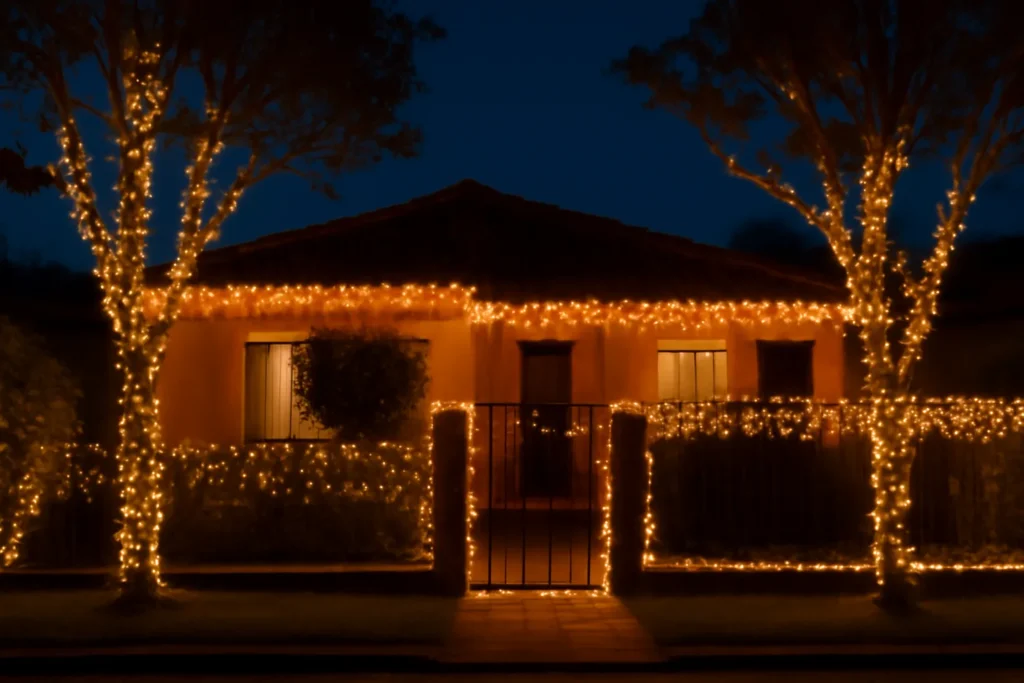
For outdoor Christmas lights, buy LED sets rated IP44 or higher and choose by spot: string lights for shrubs and railings, curtain lights for eaves and windows, rope lights for rooflines and a projector for the front of the house. Plug everything into extension cords rated for outdoor use, on an outlet protected by a ground-fault device (a GFCI outlet or breaker, called an RCD in many countries), and don’t overload the circuit.
Anyone who has hung lights outside knows the moment: the last string ends a foot short of the corner, and the store is already closed. The quick table below shows what to buy for each spot and how to measure it before you leave the house. Further down you’ll find the safe installation steps, real energy numbers and the looks for 2026.
What to buy for each spot, and how to measure it
| Spot | Best type of light | How to work out how much |
|---|---|---|
| Eaves and gutters | Curtain (icicle) lights | Eave length divided by curtain width: an 8 m (26 ft) eave with 2 m (6.5 ft) curtains = 4 pieces |
| Roofline and window outlines | Rope lights | Add up the perimeter: outlining a 10 × 8 m (33 × 26 ft) facade takes 36 m (118 ft) |
| Shrubs, railings and porch | LED string lights | Measure each railing and shrub; a typical 10 m (33 ft) string carries 100 bulbs |
| The whole front of the house | One projector | One unit about 3 m (10 ft) away covers a facade 5 to 6 m (16 to 20 ft) wide |
| Apartment balcony or window | A short string or small curtain | A 3 m (10 ft) string around a window frame; a 1 × 1.5 m (3 × 5 ft) curtain on the balcony door |
Write the measurements on a quick sketch of the house, add them up per spot and buy one extra set. It’s much easier to return a spare than to hunt for a matching string in mid-December.
Why outdoor lights are worth it (and cost less to run than you think)
Decorating the outside of your home with Christmas lights isn’t only about looks. It creates a sense of community and cheer that spreads through the whole neighborhood. It’s the part of your decorating that everyone sees, from people driving by to the neighbors next door.
Beyond the visual impact, well-planned outdoor lights make your home safer by lighting up paths, gates and entryways that would otherwise be dark. And with today’s LED technology, the extra load on your electric bill is small.
Practical benefits of outdoor holiday lighting
- Curb appeal: a well-lit facade stands out in the neighborhood for all the right reasons
- Safety: light in the yard and at the entrance cuts down on dark corners
- Instant holiday mood: nothing else creates a Christmas atmosphere as quickly
- A purchase that lasts: good-quality LED lights last 5 to 10 years of seasonal use
- Controlled energy use: LED bulbs use only a fraction of the energy of old incandescent bulbs, so even a generous display draws modest power
Types of outdoor Christmas lights: string, curtain, rope, projector and figures
The holiday lighting market has grown enormously in recent years. There’s an option for every style, budget and type of outdoor space. Understanding the differences between the types is the first step toward buying smart and putting together a display that hangs together.
Classic string lights
The classic of all classics. String lights, steady or twinkling, are the most versatile option in the category: they work on railings, shrubs, yard trees, eaves, porches and windows. For outdoor use, always choose models with an IP44 rating or higher, which means they’re protected against rain and moisture.
A 10 m (33 ft) string with 100 LED bulbs draws only about 6 W on average. A 20 m (66 ft) string with 200 bulbs, on for 6 hours a day for 30 days, uses roughly 2 kWh in total. To see what that means on your own bill, multiply the kWh by the rate per kWh printed on your statement. For most households, it’s a very small line item.
Curtain lights (icicle or waterfall lights)
Curtain lights, also sold as waterfall or cascade lights, are perfect for eaves, windows, gates and walls. They create a “falling light” effect that is absolutely charming. The most common models are 2 to 3 m (6.5 to 10 ft) tall, 1 to 5 m (3 to 16 ft) wide, and come with steady, twinkle, wave and fade modes.
To work out how many curtains you need: measure the length of the eave and divide by the width of each curtain. An 8 m (26 ft) eave with 2 m (6.5 ft) curtains = 4 pieces. Most kits include end connectors that let you link several units from a single outlet, as long as you stay within the maximum number of connected sets printed on the label.
Rope lights (tube lights)
Rope lights are flexible PVC tubes with LEDs inside that bend into almost any shape: rooflines, letters, stars, reindeer or tree silhouettes. They’re very tough outdoors and handle rain, wind and changes in temperature well.
Sold in rolls of 5, 10 or 50 m (16, 33 or 164 ft), rope lights draw about 5 to 7 W per meter (roughly 1.5 to 2 W per foot). Outlining a 10 m × 8 m (33 × 26 ft) facade, a 36 m (118 ft) perimeter, means a total draw of 180 to 252 W while the lights are on. Run for 6 hours a day over 30 days, that adds up to roughly 32 to 45 kWh for the month.
Christmas light projectors and spotlights
Laser and LED projectors cast stars, snowflakes, reindeer and other motifs straight onto the front of the house or the yard. They’re easy to set up, usually with a stake you push into the ground, and a single unit can cover up to about 70 m² (750 sq ft).
Newer models have a built-in timer, a remote control and Wi-Fi so you can schedule them from your phone. For a facade 5 to 6 m (16 to 20 ft) wide, one projector placed about 3 m (10 ft) away covers the whole area with a striking effect.
Lighted figures and silhouettes
A 1.2 m (4 ft) LED Santa, a 2 m (6.5 ft) sleigh with reindeer, hanging stars, a lighted nativity scene: lighted figures are the big-ticket items for anyone who wants an outdoor display people remember. They’re ideal for spacious yards, wide entrances and neighborhoods that hold Christmas decorating contests.
Simple wire-and-LED figures are the most affordable, while larger, more elaborate pieces can cost several times as much. The smart move is to invest in one or two standout pieces rather than filling the space with lots of small ones. The result always looks more elegant and polished.
Side by side: power draw, water rating and cost of each type
| Type | Best use | Typical power draw | Water resistance | Relative cost |
|---|---|---|---|---|
| LED string lights | Shrubs, railings, windows | 3 to 10 W per string | IP44 or IP65 | Low |
| Curtain lights | Eaves, walls, gates | 10 to 30 W per unit | IP44 | Low to medium |
| Rope lights | Outlines, shapes, silhouettes | 5 to 7 W per meter | IP65 or IP67 | Priced by length |
| Laser projector | Facade, large yard | 5 to 20 W per unit | IP65 | Medium |
| Lighted figures | Yard, entrance, focal point | 10 to 80 W per figure | IP44 to IP65 | Medium to high |
How to install outdoor Christmas lights safely, in 9 steps
Safety is non-negotiable when you put up lights outside. Wiring exposed to rain, overloaded outlets and makeshift splices are real risks for short circuits and electric shock. Following the right steps protects your family and your home. For more on picking and using lights, see our guide to how to choose Christmas lights and use them safely.
Step by step for a safe installation
- Plan before you buy: measure every area you want to decorate and figure out how many feet of string or rope light you need before you head to the store
- Check the box and the plug: the packaging should clearly state the voltage, the maximum wattage of the set and the manufacturer or importer, and the product should carry a recognized safety certification mark, such as UL or ETL in the US, or the equivalent where you live
- Check the IP rating: outdoors, never use products rated below IP44, and look for an explicit “outdoor use” label
- Don’t overload the outlet: add up the wattage of everything you plan to plug in and compare it with the capacity of the circuit and with the maximum load printed on the light sets and extension cords
- Use extension cords certified for outdoor use: indoor cords aren’t safe in damp areas or out in the rain
- Use ground-fault protection: a GFCI outlet or breaker (RCD) cuts the power automatically if there’s a short or a current leak, which is essential for outdoor setups
- Secure the wires with the right clips: use plastic hooks and clips made for holiday lights; nails and metal staples damage the insulation
- Turn them off when you leave and when you go to bed: even with quality products, never leave lights on unattended for long stretches; a timer makes this automatic
- Store them properly after Christmas: wind the strings on reels or put them back in their original boxes to avoid tangles and damaged connectors
Outdoor Christmas lighting trends for 2026: warm white, apps and low energy
Three approaches will make your outdoor decor feel current: a well-defined color palette, app control and low-energy products.
Modern color palettes
Warm white is still the most elegant and timeless choice for the front of a house. One combination that works especially well is warm white with gold or copper accents, which feels luxurious without going overboard. Icy blue and silver are also showing up strongly, especially paired with modern geometric motifs.
For anyone who prefers something brighter, multicolor is back, but in a curated way: instead of the full rainbow, the trend is to choose two or three complementary colors, such as red, green and gold for a traditional look, or pink, lilac and white for a contemporary one.
Automation and app control
Plenty of products now work with voice assistants such as Google Assistant and Alexa, or with a phone app. You can schedule when the lights turn on, create color sequences and sync the lights to Christmas music, building a homemade light show worthy of a theme park.
Sustainability as a priority
Environmental awareness has arrived at Christmas for good. Swapping old incandescent strings for LEDs cuts the energy use of your display dramatically. Very low-energy lights, recyclable materials and sustainable packaging are also shaping what people buy.
Outdoor lighting ideas for every size of home, from a balcony to a big yard
No matter how much outdoor space you have, there’s always a creative, good-looking way to use Christmas lights outside. In apartment buildings, even one small lit balcony makes a difference to the whole facade.
For apartments and small balconies
- A 3 m (10 ft) string with 30 LED lights around the frame of the main window
- A 1 × 1.5 m (3 × 5 ft) curtain light on the balcony door
- A lantern or planter with an arrangement of branches and battery-powered LED lights
- A lighted garland on the balcony railing (solar models don’t need an outlet)
For houses with a small yard
- String lights wrapped around one or two shrubs by the entrance
- Curtain lights along the eave or in the main window
- A laser projector on the ground aimed at the front of the house
- A small lighted figure, such as a star or a reindeer, as a focal point in the yard
For large houses with a big yard
- Rope lights outlining the roof and windows
- String lights wrapped around every tree and shrub in the yard
- Standout lighted figures: Santa, reindeer, a nativity scene
- A lit path from the sidewalk to the front door with light-up stakes
- An extra laser projector to cover the back or side of the house
In homes with a garden, the lights pair naturally with outdoor greenery, wreaths and planters; on an apartment balcony, a garland on the railing and a lantern or two go a long way.
Christmas lights in a summer Christmas
If your Christmas falls in summer, as it does in Australia and New Zealand, the evenings stay light until late, so the display only really shows once it’s properly dark. Set the timer to switch on later rather than at dinnertime, and you’ll save energy without losing any of the effect. Long sunny days are also good news for solar lights, which get a full charge, and it’s worth checking the operating temperature range on the label of anything that will sit in direct afternoon sun.
Pick a palette, keep it simple
The secret to a display that looks good is consistency: choose a color palette, settle on a style (classic, modern, minimalist or over-the-top) and stick with it. A simple, well-executed display always looks better than a pile of pieces that don’t go together, whether it’s one string of lights in the window or a fully lit yard with figures, projectors and rope lights.
Practical tip: before you buy any outdoor lights, make a “decor map”: a simple sketch of the front of your house with the real measurements of every area you want to light. It prevents impulse buys and leftover lights you don’t need, and saves you the frustration of getting home a few feet short.
May your lights come on at the first try this year, and may someone walking past slow down for a second just to look.
Frequently asked questions about outdoor Christmas lights
Can I use any Christmas lights outside the house?
No. Lights used outdoors need at least an IP44 rating, which means protection against splashing water. Indoor strings (usually IP20) aren’t safe in areas exposed to rain or moisture. Before you buy, check the package for an outdoor-use label, the voltage and the wattage, and make sure the product carries a recognized safety certification mark.
How much electricity do outdoor Christmas lights use?
With modern LEDs, surprisingly little. A complete outdoor display with about 500 LED bulbs (strings, a curtain and a projector) draws around 50 to 80 W. On for 6 hours a day for 30 days, it uses roughly 9 to 14 kWh for the whole period. Multiply that by the rate per kWh on your electric bill to estimate the cost.
Do solar lights work well for outdoor Christmas decorating?
Yes. Current models usually have batteries that run for 8 to 12 hours after a full charge of 6 to 8 hours of sun. They’re ideal for yards and areas without a nearby outlet. In sunny, warm climates they’re an excellent sustainable and low-cost option; where winter days are short and cloudy, expect shorter run times.
How far ahead should I put up outdoor Christmas lights?
Many people put up outdoor lights in the first or second week of December. Installing early, from around November 20, gives you time to fix any technical problem, such as an overloaded outlet, a string that’s too short or the wrong clips, before the holidays arrive.
How should I store Christmas lights so they last longer?
The biggest enemy of Christmas lights is poor storage, which causes knots, sharp bends and damaged connectors. Wind the strings on cardboard reels or extension cord reels and keep them in a rigid box, somewhere dry and well ventilated, away from moisture and direct sunlight. With proper care, quality LED lights easily last 5 to 10 seasons.