DIY Advent Calendar: 5 Easy Ways + What to Put Inside (24 Days)
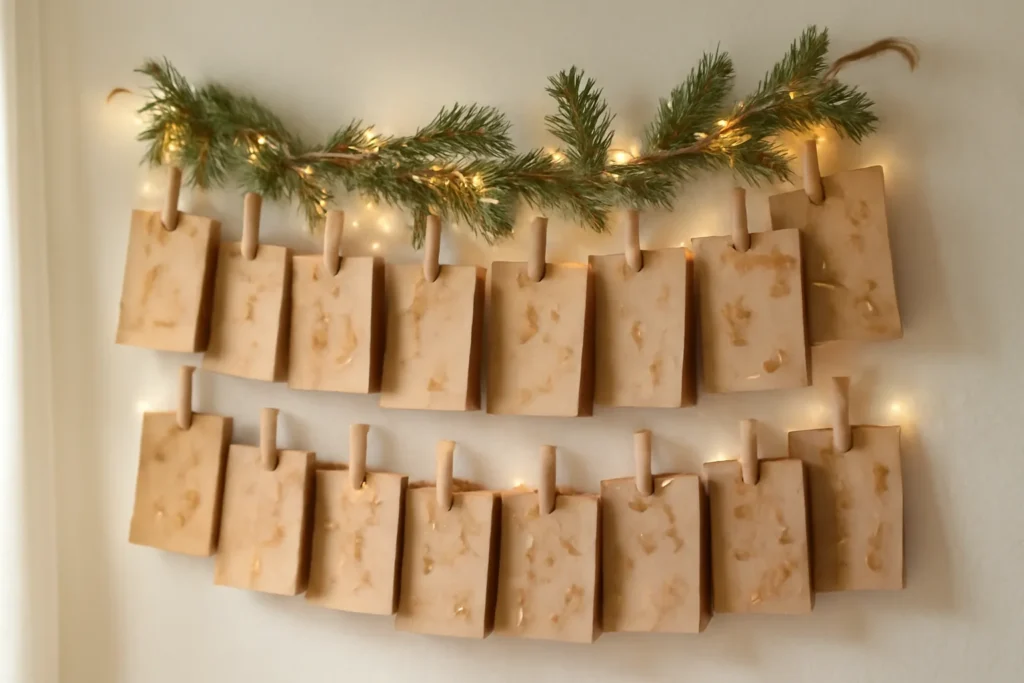
A DIY Advent calendar needs 24 numbered pockets, one for each day from December 1 to December 24, and the quickest version is 24 kraft paper bags clipped to a length of twine. Each pocket holds a small surprise: a note, a family activity, a little treat or a piece of candy. You can also make one with envelopes, matchboxes, toilet paper rolls or jars, spend very little, and get the kids involved from the very first step.
In most homes, someone starts asking “how many days until Christmas?” long before December. A homemade calendar turns that question into a small daily ritual, and it doesn’t have to be 24 days of chocolate. The ready-made plan for all 24 days is in the table further down, mixing activities, small treats and notes, so you only have to fill the bags.
Below you’ll also find when to start, the easiest formats, step-by-step instructions for a paper bag garland calendar, ideas for what to put in each pocket, a ready-made plan for all 24 days and the safety basics, especially with little kids and chocolate in a warm room.
When to start: December 1, or November 29 to follow Advent
The Advent calendar is a tradition that started in Germany and spread around the world. Each day in December, you open one pocket, and the excitement for Christmas builds along with the countdown.
The most common format runs from December 1 to December 24, with 24 pockets. In 2026, the season of Advent begins on Sunday, November 29. If you’d like to follow the church calendar from that first Sunday, make 26 pockets, from November 29 to December 24. Some families also add one for the 25th.
To have the first bag ready on December 1, finish putting the calendar together by the end of November. You can fill it a little at a time, but ideally the whole first week should be ready to go. Blocking out one evening in late November for this makes it much easier to fit in among everything else.
If you want to follow the church calendar, see when Advent starts in 2026.
5 easy formats (the paper bag garland is the fastest)
Paper bags on a garland
Kraft paper or fabric bags, numbered and clipped to a length of twine with clothespins. It’s the simplest format and fits on any wall, window or staircase.
Envelopes on the wall
Perfect for calendars made of notes and activities. The envelopes can form a tree shape on the wall, attached with tape that won’t damage the paint.
Toilet paper rolls
The rolls turn into little pods: fold the ends in, decorate and number them. Stacked in a tree shape or tucked inside a box, they look adorable. It’s also a nice way to give materials headed for the recycling bin a second life.
Matchboxes
Empty, covered in paper and glued together, they make a tiny chest of drawers. They hold folded notes and very small treats. Remove the matches and dispose of them carefully before you start.
Felt pockets
A felt or fabric backing with 24 small pockets sewn or glued on. It takes more work, but it lasts for years and becomes a family tradition.
Step by step: a paper bag garland calendar in one evening
You’ll need: 24 kraft paper bags, 24 small clothespins, about 2 m (6.5 ft) of twine, markers or cut-out numbers, glue and tape, and the contents for each day.
- Pick the spot: an empty wall, a window, the side of a bookcase or the stair railing. Measure the space so you know how many rows of twine you’ll need.
- Number the bags: write or glue on the numbers 1 to 24. Stamps, paper stars and ribbons help make each one a little different.
- Prepare the contents: set aside the items for each day and write the activity notes before you close the bags.
- Close them: fold the top of each bag over twice and clip it shut with its clothespin, which then goes on the garland.
- Hang the garland: stretch the twine and secure the ends with adhesive hooks or tape. Hang the bags out of order, so hunting for the day’s number becomes part of the fun.
- Set the rules: one bag a day, always at the same time, like at breakfast or after school.
What to put inside: mix 4 kinds of fillers, not just candy
The secret is variety. A calendar full of nothing but candy gets old fast and adds up at the checkout. Mix these four kinds of fillers:
- Family activities: putting up the tree, baking cookies, watching a Christmas movie, writing a letter to Santa, going out to see the lights around town. Our list of Christmas activities to do together has ideas for almost every day.
- Small treats: stickers, colored pencils, an ornament for the tree, a fun pair of socks, a bookmark.
- Sweets: chocolates, candies or cookies, in small amounts and alternated with other fillers.
- Notes and kind acts: a compliment, a family memory, a kindness challenge like helping someone at home or picking out a toy to donate.
The calendar works for teens and adults too: recipes, sweet notes, tea bags, date-night coupons, a song a day or small Christmas to-do tasks.
For little ones, the notes can suggest simple crafts, coloring pages or songs that suit preschoolers.
A ready-made plan for all 24 days (one filler per day)
| Day | Filler | Day | Filler |
|---|---|---|---|
| 1 | Note: today we put up the tree | 13 | Challenge: help someone at home |
| 2 | Christmas stickers | 14 | Cookie or chocolate |
| 3 | Note: write a letter to Santa | 15 | Note: family game night |
| 4 | Chocolate or candy | 16 | Small ornament for the tree |
| 5 | Note: make paper ornaments | 17 | Note: make cards for the grandparents |
| 6 | Colored pencils or crayons | 18 | Candy or gum |
| 7 | Note: Christmas movie with popcorn | 19 | Note: go see the Christmas lights around town |
| 8 | A compliment written by the family | 20 | Fun socks or accessory |
| 9 | Note: pick out toys to donate | 21 | Note: help plan Christmas Eve dinner |
| 10 | Bookmark or keychain | 22 | Chocolate |
| 11 | Note: bake cookies together | 23 | Note: wrap presents together |
| 12 | Small puzzle | 24 | Note: tonight is Christmas Eve |
Adjust the activities to your family’s routine. If a day gets hectic, swap the activity for a note or a small treat and save the outing for the weekend.
Some days can be story days, with a Christmas book read aloud before bed.
If your December is in summer
For families who spend Christmas in the warm months, as in Australia and New Zealand, the calendar works just as well with an outdoor twist. Swap a few indoor notes for a picnic dinner, a backyard water fight, an evening walk to see the lights once it finally gets dark, or making ice pops for Christmas Day. Paper bags in a hot room also fade and curl less if the garland hangs away from windows that get afternoon sun.
Safety and tips so it doesn’t become one more chore
- Little kids: for children who still put things in their mouths, avoid small pieces, hard candy, marbles and toys with parts that come loose.
- Button and coin batteries: don’t include toys that use them for young children; they are dangerous if swallowed.
- Warm rooms: chocolate melts easily in bags hanging near a heater, a sunny window or anywhere in a warm climate. Keep the chocolate in the fridge and put a “good for one chocolate” note in the calendar instead.
- Allergies and restrictions: if someone in the family has a food allergy or medical advice about sugar, choose activities and small treats instead of sweets.
- Keep it away from flames: paper and fabric shouldn’t be near lit candles or the stove.
- Prep ahead: assembling everything at once saves you a scramble every night.
- Set a budget: simple treats and notes are worth as much as gifts. What sticks in the memory is the moment of opening it together.
The most common mistake (almost everyone makes it once) is filling all 24 bags with the same thing and watching the excitement fade by day 10. Variety keeps it alive, and if a day is chaotic, a note that says “tonight, hot chocolate in pajamas” counts.
May your countdown be less about what’s inside the bag and more about the minute everyone stops to open it together.
Frequently asked questions
When does an Advent calendar start?
The most common format runs from December 1 to December 24, with 24 pockets. In 2026, the season of Advent begins on Sunday, November 29; if you want to start that day, make 26 pockets.
What do you put in a kids’ Advent calendar?
Mix family activities, like putting up the tree and baking cookies, with small treats like stickers and pencils, a few sweets and notes with compliments or kindness challenges.
How do you make an inexpensive Advent calendar?
Use kraft paper bags on a twine garland, envelopes, toilet paper rolls or empty matchboxes. Fill them with activity notes and a few small treats, alternating with sweets.
Can you put chocolate in an Advent calendar when it’s warm?
You can, but chocolate melts easily in hanging bags. The easiest fix is to keep it in the fridge and put a note in the calendar that’s good for one chocolate.