When Does Advent Start 2026? The 4 Sundays and Candle Colors
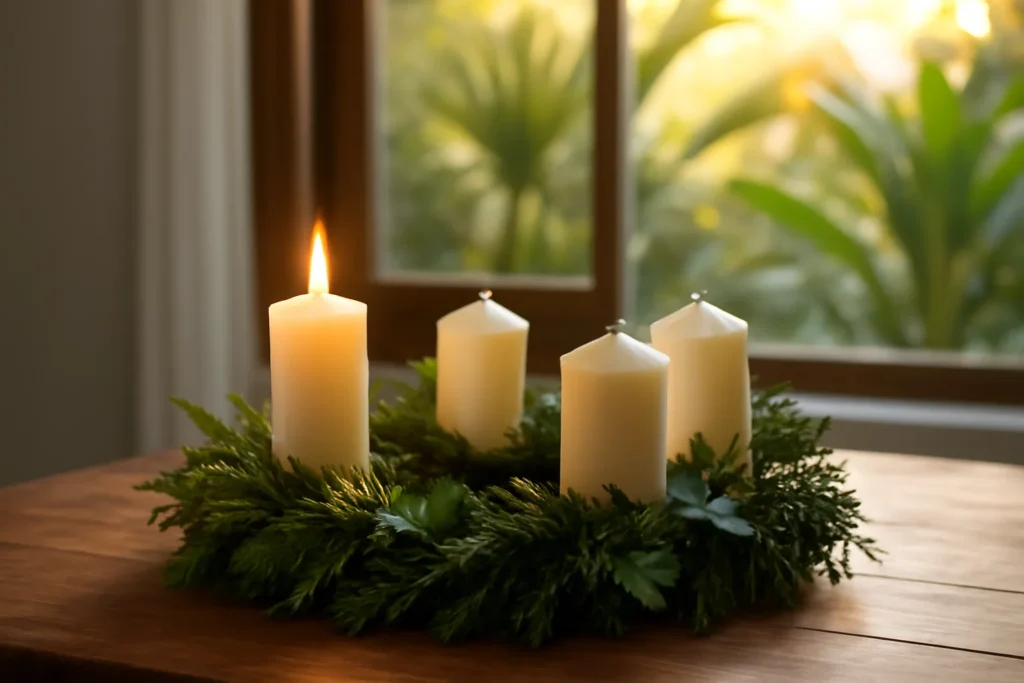
Advent 2026 begins on Sunday, November 29, and runs until the evening of Thursday, December 24. There are four Sundays, and on each one a new candle on the wreath is lit. The third candle is the pink one, and it’s the one almost everyone lights out of order. Here are the four dates, the color of each candle and simple ways to count down the days with kids.
| Sunday | Date in 2026 | Candle to light | What it recalls |
|---|---|---|---|
| 1st Sunday | November 29 | Purple | Hope |
| 2nd Sunday | December 6 | Purple | Peace |
| 3rd Sunday (Gaudete) | December 13 | Pink | Joy: Christmas is near |
| 4th Sunday | December 20 | Purple | Love |
Each Sunday, the new candle joins the ones before it, so on December 20 all four burn together. The names given to each candle vary a little between parishes and churches, but the color order stays the same. The step-by-step assembly is in our guide to the Advent wreath, candle order and colors.
If you’re reading this while the calendar is already filling up with school concerts and office parties, you’re not late. Advent was made for exactly this kind of month: one candle and a few quiet minutes a week, and the rest can wait.
What Advent is, and why its color is purple
Advent is the season of preparation for Christmas in the Christian calendar, marked by four Sundays. The word comes from the Latin adventus, meaning “arrival” or “coming”: it is a time of waiting and getting ready for the coming of Jesus.
For the Catholic Church and several other Christian churches, including the Anglican and Lutheran traditions, Advent opens the liturgical year, the calendar that sets the rhythm of celebrations throughout the year. It is a season of expectation, not yet of celebration: the idea is to prepare your heart for Christmas.
The season has a double meaning. In the Catholic liturgy, the first weeks recall the waiting for Christ’s return at the end of time, and from December 17 on, the focus turns directly to his birth in Bethlehem. The readings at Mass feature figures such as the prophet Isaiah, John the Baptist and Mary.
The color of Advent is purple, associated with preparation and repentance. On the third Sunday, called Gaudete Sunday (Latin for “rejoice”), rose may be used instead, a sign that the joy of Christmas is near.
That restraint shows up in other details, too. At Sunday Masses during Advent, the Gloria is not sung, and the liturgy calls for moderation with flowers and musical instruments. All of it is saved for Christmas night, when the Gloria returns in full voice and the church fills with celebration.
When Advent starts in 2026: the full calendar
Advent begins on the fourth Sunday before Christmas. That’s why the date changes every year, but it always falls between November 27 and December 3. Since Christmas 2026 lands on a Friday, the calendar looks like this:
| Occasion | Date | Highlight |
|---|---|---|
| First Sunday of Advent | Sunday, November 29, 2026 | Advent and the new liturgical year begin |
| Second Sunday of Advent | Sunday, December 6, 2026 | Falls on St. Nicholas Day |
| Third Sunday of Advent | Sunday, December 13, 2026 | Gaudete Sunday, the Sunday of joy |
| Fourth Sunday of Advent | Sunday, December 20, 2026 | The last and shortest week begins |
| Christmas Eve | Thursday, December 24, 2026 | Advent ends at nightfall |
| Christmas Day | Friday, December 25, 2026 | The Christmas season begins |
In 2026, Advent will last 26 days. Because the fourth week only runs from Sunday, December 20, to Thursday, December 24, it’s worth getting your shopping and preparations done during the third week.
Many families also use the first Sunday of Advent as the day to put up the tree, which in 2026 falls on November 29. Here’s when to put up your Christmas tree in 2026, along with the other traditional dates, including when to take it down.
Not every Christian tradition follows this format. Orthodox churches keep a fast of about 40 days before Christmas, and in the Ambrosian Rite, used in the area around Milan, Advent lasts six weeks.
How Advent began
There’s no exact date for the birth of Advent. Historians find the first references to a time of preparation for Christmas between the 4th and 6th centuries, taking different forms in different regions. In Gaul, for example, there was a longer period of fasting that started around November 11, the feast of St. Martin.
In Rome, Advent was eventually set at four Sundays, a format traditionally linked to Pope Gregory the Great at the end of the 6th century. Over the Middle Ages, its fasting character softened, and Advent came to be understood above all as a season of joyful waiting and preparation.
The Advent wreath: what each candle means
The Advent wreath as we know it is a fairly recent tradition. It is usually credited to the Lutheran pastor Johann Hinrich Wichern, who in 1839, at a home for poor boys in Hamburg, Germany, built a large wooden wheel with candles so the children could count the days until Christmas. Over time, the idea was simplified to four candles, one for each Sunday, and spread to churches and homes.
The circle symbolizes eternity, and the evergreen branches stand for life and hope. Each Sunday, one more candle is lit, and the growing light represents Christmas drawing near.
Candle colors vary by tradition:
- three purple and one rose, the combination most closely tied to the Catholic liturgy, with the rose candle lit on the third Sunday;
- four red, very common in Germany;
- mixed colors, such as green, red, purple and white, which you’ll find in some parishes and family homes;
- a white candle in the center, added by some families and lit on Christmas Day.
The names given to each candle also vary from one community to the next. A widely used sequence is hope, peace, joy and love, but there’s no official list. If you light candles at home, set the wreath on a fireproof plate or tray and never leave a flame burning unattended.
In many congregations, the wreath kicks off the season, and you’ll find more ideas in our guide to simple Christmas church decorations.
The Advent calendar starts on December 1, not on Advent Sunday
The Advent calendar, with a little window or pocket for each day, began in German-speaking homes in the 19th century, when families marked the countdown with chalk lines on the door or with religious pictures. The first printed calendars appeared in Germany in the early 20th century.
One practical detail: most calendars run from December 1 to 24 and don’t follow the liturgical start of Advent. In 2026, Advent starts two days earlier, on Sunday, November 29. You can use those two days to get the calendar ready with the kids.
The wreath and the calendar aren’t only for Catholics. Churches that follow the liturgical calendar, such as the Lutheran and Anglican churches, also observe Advent, while many evangelical churches don’t use that calendar and celebrate Christmas in other ways. At home, every family can choose what fits its own faith.
How to observe Advent as a family, one Sunday at a time
Advent overlaps with the end of the school term, holiday parties and year-end deadlines. That makes it a good excuse to slow down during a month that’s usually rushed, setting aside a fixed moment each week, like Sunday lunch or dinner, to light the wreath candle. A few simple ideas:
- put the wreath together on the weekend of November 28 and 29 and light the first candle at a family meal;
- fill the calendar with small tasks, not just candy: write a card, call a relative, set aside a toy to donate;
- set up the nativity scene little by little, adding figures over the weeks;
- pick one act of kindness or charity each week;
- spread the Christmas dinner prep across the weeks so you reach December 24 without a last-minute scramble.
The base of an Advent wreath can be made just like a homemade Christmas wreath, using evergreen branches on a simple ring. For time with the kids, try these family Christmas activities.
Building the nativity scene gradually, figure by figure, is another way to follow the weeks, and it’s worth learning the meaning of each nativity figure.
If Christmas falls in summer where you live, as it does in Australia and New Zealand, Advent arrives together with the end of the school year and the start of the long holidays. Fresh greenery wilts quickly in the heat, so an artificial or dried wreath holds up better, and candles soften on a sunny table: keep the wreath out of direct sun, or use LED candles if the room gets hot.
However you mark it, may each Sunday give your family a few calm minutes together, and may the fourth candle find you ready rather than rushed.
Frequently Asked Questions
When does Advent start in 2026?
On Sunday, November 29, 2026. Advent always begins on the fourth Sunday before Christmas, and this year it runs until the evening of Thursday, December 24.
What is the first Sunday of Advent in 2026?
It’s Sunday, November 29, 2026, the day the first candle of the wreath is lit. The other Sundays are December 6, 13 and 20.
How long does Advent last?
It always includes four Sundays, but its length varies from 22 to 28 days, depending on which day of the week Christmas falls. In 2026, Advent lasts 26 days.
What is the color of Advent?
Purple, which expresses preparation and repentance. On the third Sunday, Gaudete Sunday, rose may be used as a sign that the joy of Christmas is near.
What does the Advent wreath mean?
The circle symbolizes eternity, the evergreen branches stand for life and hope, and the four candles mark the Sundays until Christmas. The light that grows each week represents the coming of Jesus.
What are the Sundays of Advent in 2026?
There are four: November 29, December 6, December 13 and December 20, 2026. Each Sunday, one more candle on the wreath is lit, until all four are burning in the last week before Christmas.
What is Gaudete Sunday, and when is it in 2026?
It’s the third Sunday of Advent, which falls on December 13 in 2026. The name comes from the Latin word for “rejoice,” which is why the rose candle on the wreath is lit that day.