Simple Church Christmas Decorations: 8 Ideas and 2026 Calendar
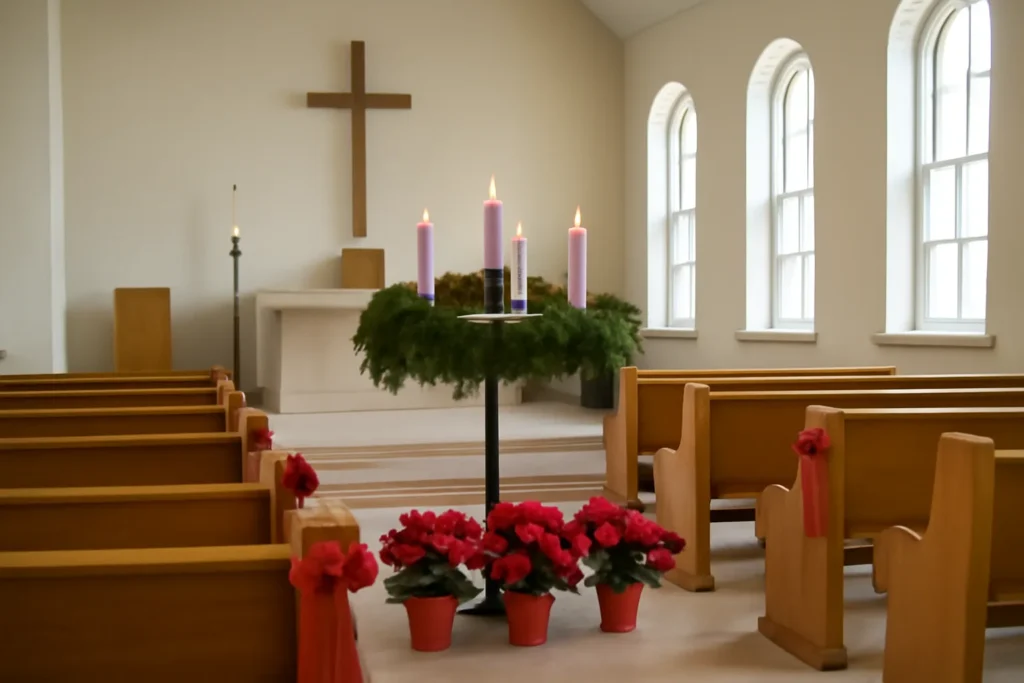
Simple, beautiful Christmas decorations for a church come down to four areas: the entrance, the altar or pulpit, the nativity scene and the lighting. Pick a short color palette, favor large pieces that can be seen from the back of the sanctuary, and agree on everything ahead of time with your priest or pastor and the team in charge.
Anyone who has helped decorate a church knows it’s a job for many hands, and it almost always happens on a weeknight after work, with someone holding the ladder and someone else looking for the extension cord. The table below sums up the four areas, and then you’ll find the 2026 calendar, the Advent wreath, eight inexpensive ideas and safety with candles, cords and exits.
| Area | What works | What to avoid |
|---|---|---|
| Entrance | One large wreath, 60 cm (24 in) or more, and lights around the door frame | Pots or banners that narrow the walkway |
| Altar or pulpit | Low arrangements on the steps or side pedestals | Ornaments on the altar table itself |
| Nativity scene | Off to one side, figures 30 cm (12 in) or taller | A spot where children block the aisle |
| Lighting | Warm light and an Advent wreath as the focal point | Candles near fabric, cords across aisles |
When to decorate: the 2026 church calendar
Church Christmas decorating works best when a small team makes the decisions, with a set budget and fixed dates. Gather three to five volunteers, check with the priest or pastor about what is and isn’t allowed, and take inventory of what’s already in storage before asking for donations.
In churches that follow the liturgical calendar, decorations follow two phases: Advent, which is more restrained, and the Christmas season, which is more festive. In 2026, the dates fall like this:
| Date | Occasion | Decorations |
|---|---|---|
| Sunday, November 29, 2026 | First Sunday of Advent | Advent wreath with the first candle lit |
| Sunday, December 6, 2026 | Second Sunday of Advent | Second candle; set up the entrance and the tree |
| Sunday, December 13, 2026 | Third Sunday of Advent | Third candle, which is rose in many congregations |
| Sunday, December 20, 2026 | Fourth Sunday of Advent | Fourth candle; nativity scene in place, still without the Baby Jesus |
| Thursday, December 24, 2026 | Christmas Eve service | Flowers, white and gold; Baby Jesus placed in the manger |
| Wednesday, January 6, 2027 | Epiphany (Three Kings Day) | The Magi arrive at the nativity scene |
Where Epiphany is moved to a Sunday, as in many US Catholic parishes, it falls on January 3, 2027, so plan the arrival of the Magi for that weekend.
Also agree on when to take everything down: some congregations remove it all after Epiphany, while others keep it up until the end of the Christmas season. That call belongs to the parish or the church leadership.
The Advent wreath: size and placement for a sanctuary
The Advent wreath kicks off a church’s Christmas decorations and marks the waiting through the four Sundays before December 25. It holds four candles on a base of evergreen branches, with one more candle lit each Sunday. In the Catholic tradition, three candles are purple and one is rose; other congregations use red or white.
- Size: to be visible from the back of the sanctuary, the wreath needs to be 60 to 80 cm (24 to 32 in) across, with candles 30 to 40 cm (12 to 16 in) tall.
- Base: a metal or wooden ring covered with artificial greenery, which won’t dry out or drop needles near the flame.
- Placement: near the altar or pulpit, on a sturdy stand, away from altar cloths and curtains.
- Drips: put small metal dishes under each candle so wax doesn’t melt onto the greenery.
Where open flames aren’t allowed, good-quality LED candles keep the symbolism intact.
Entrance and exterior: one strong focal point
The entrance is the part of the church the most people see, including those who just pass by on the street. A large wreath on the main door, 60 cm (24 in) across or more, with a bow made of wide ribbon, already transforms the facade. A volunteer group can make it the same way as a homemade wreath, just on a larger scale.
- A string of outdoor-rated lights around the door frame or entrance arch.
- Two large pots of poinsettias or other foliage, one on each side of the door.
- A fabric banner with a welcome or Merry Christmas greeting.
- Ribbon bows on the pews along the center aisle, every two or three pews.
None of this should narrow the walkway. Doors need to open fully, and the path to the exits has to stay clear during the packed Christmas Eve services on December 24.
Wreaths and bows at the entrance follow the same logic as any front door: one strong focal point reads better from a distance than many small pieces.
Altar and sanctuary: what changes from Advent to Christmas
At the altar, Christmas decorations are there to frame, never to hide. The altar is not a shelf for ornaments: low arrangements around it, on the steps or on side pedestals work better than pieces set on the altar table itself. The ambo or pulpit also needs to stay visible.
| Element | During Advent | At Christmas |
|---|---|---|
| Fabric color | Purple | White or gold |
| Flowers | Few and understated | Red and white, in greater numbers |
| Plants | Green foliage | Poinsettias, anthuriums, white lilies |
| Light | Advent wreath as the focal point | Warm lights and candles |
In the Catholic tradition, Advent calls for moderation with flowers, saving the full joy for Christmas. When in doubt, ask the liturgy committee.
Where Christmas falls in summer, as in Australia and New Zealand, a full church on a warm evening is hard on fresh flowers and greenery. Choose hardy foliage for the Advent weeks, bring in the cut flowers on December 23 or the morning of the 24th, and keep candles well away from fans and open windows, where a draft can push the flame sideways. Good LED candles are a sensible choice near any fan.
The nativity scene: where to put it and when the Baby Jesus arrives
The church’s nativity scene should sit off to one side, in a visible, accessible spot where children can come up close without blocking traffic. Figures 30 cm (12 in) tall or larger are easy to see; smaller pieces need a raised base, such as a table draped in burlap.
The custom is to set up the scene ahead of time, leave the manger empty and place the Baby Jesus during the Christmas Eve service on December 24. The Magi can start far away and move closer little by little, arriving on Epiphany.
In Protestant churches that don’t use statues or images, a setting with a wooden manger, straw, a star overhead and a reference to Luke 2 serves the same purpose of reminding everyone what the celebration is about. A short sign next to the display explaining the meaning of Christmas can complete it.
To position each piece, see how to set up a nativity scene and what it means.
8 simple, inexpensive ideas for decorating a church
- Kraft paper stars hung on fishing line along the sides of the sanctuary.
- A giving tree with donation request tags that members take and bring back with a gift.
- LED candles in the windows, visible from outside with no fire risk.
- Fabric on the columns, in strips of white or gold voile tied with ribbon.
- Ornaments from religious education or Sunday school, made by the kids in November.
- Evergreen sprigs on the pews, each one tied with a red bow.
- Lanterns on the front steps, with LED candles inside.
- A message wall at the entrance where each family can write something they’re thankful for this year.
Reusing pieces from one year to the next is what helps the congregation’s budget the most. Store the sturdy items carefully and add only one or two new touches each year.
Explaining to the congregation what the star, the bell and other decorations mean adds depth to the display.
Safety with candles, cords and emergency exits
Safety when decorating a church takes more care than at home, because the space holds many people at the same time. Assign one person to light and put out the candles at each service, and keep a candle snuffer close by.
- Keep candles away from fabric, dried flowers, paper and curtains.
- No cords running across aisles; if it can’t be avoided, use a floor cord cover.
- Use lights with a recognized safety certification (such as UL or ETL), rated for outdoor use if they go outside, and don’t overload outlets.
- Churches with older wiring should have an electrician check the load before adding lights.
- Never cover fire extinguishers, emergency exits or exit signs.
- Work at height always with two people and a stable ladder.
When you take everything down, store each set in a labeled box (entrance, altar, nativity, wreath) and update the inventory for next year.
A church decorated by many hands rarely looks like a catalog, and it doesn’t need to. May the work bring your team together, and may everyone who walks in on Christmas Eve feel welcome from the door.
Frequently Asked Questions
What color are Christmas decorations in a Catholic church?
During Advent, the liturgical color is purple, with rose on the third Sunday. Starting with the Christmas Eve service on December 24, white and gold come in to mark the Christmas season.
When should a church put up its Christmas decorations?
The Advent wreath goes up on the first Sunday of Advent, which in 2026 is November 29. The full decorations, with flowers and the Baby Jesus in the nativity scene, should be ready for the Christmas Eve service on December 24.
Can poinsettias be used inside a church?
Yes, and they’re one of the most popular Christmas plants. Keep the pots in a bright spot, water without soaking the soil, and remember that the milky sap can irritate skin.
Do Protestant churches decorate for Christmas?
Many use lights, a tree, a star and a nativity setting, but the custom varies by denomination. Each church’s leadership decides what’s part of the decorations.